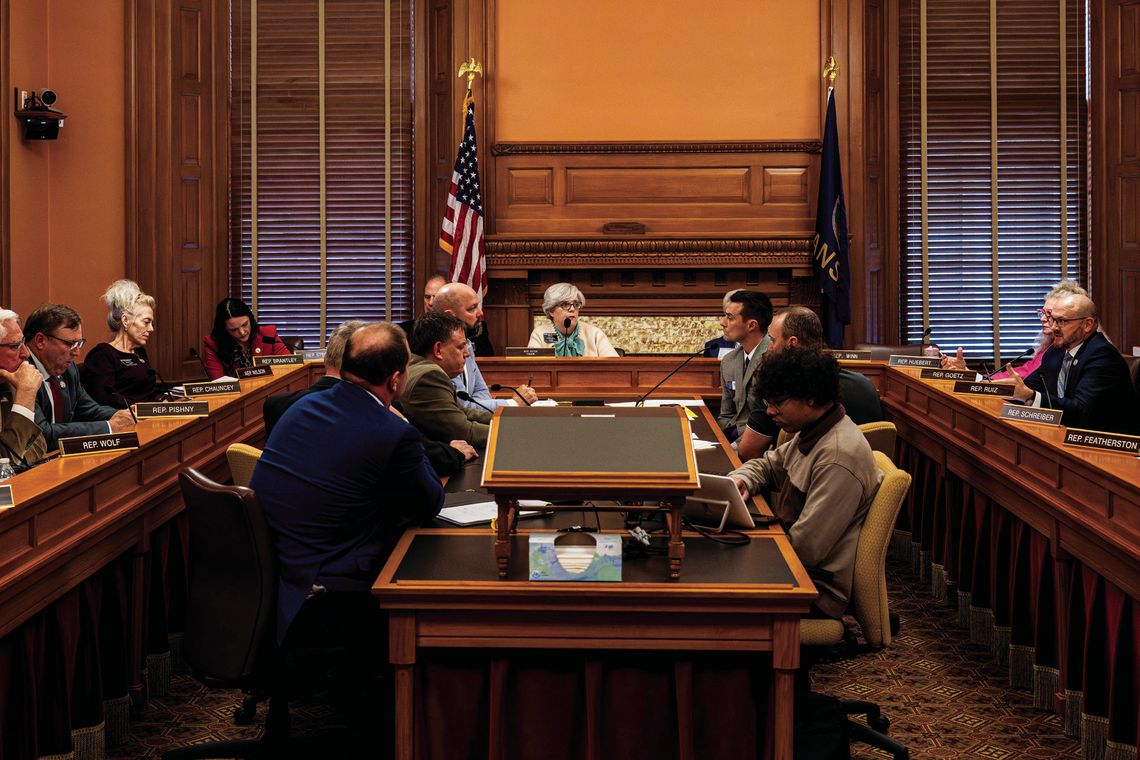
TOPEKA — Holding a roundtable with educators from across the state, the Kansas State Legislature’s House Committee on Education discussed the KSHSAA private school multiplier on Wednesday.
In addition to the committee members, the roundtable included Nemaha Central Athletic Director Kelly Williams, Paola Principal Jeff Hines, Marion Principal Donald Raymer, Rep. Chuck Smith from Pittsburg, Jamie Finkeldei from the Diocese of Wichita and Geoff Andrews, the superintendent of the Catholic Diocese of Salina.
Bill Faflick, the KSHSAA executive director, and various association staffers were also in attendance but did not participate in Wednesday’s roundtable. The education committee also held a public hearing on the issue on Tuesday.
The bill up for debate, H.B. 2176, would grant KSHSAA autonomy to install the private school multiplier, which passed a vote of member schools in 2022 and has stalled in the legislature ever since.
“Our membership has said it’s our answer, so that’s what we’re pursuing,” Faflick said. “We have some more information, so things can change. It’s been a few years since we took the pulse of our membership. But those are the marching orders until things change.”
One topic floated by committee members and advocated on the roundtable by opponents to the multiplier was the ability for private schools to voluntarily move up a classification.
Finkeldei, who is also the vice president of the Kansas Association of Independent and Religious Schools (KAIRS), opposes the multiplier. He stated during the roundtable that Bishop Miege, a private school in Class 4A, would voluntarily move up to Class 5A if allowed to do so.
“It’d remove the question mark on whether some of these private schools would move up or not,” Hines said. “It’s been floated that several schools would do it. But the proof is in the pudding.”
Rep. Abi Boatman of Wichita said she believes KSHSAA should maintain authority to govern its classifications.
“For now, I feel confident in KSHSAA’s ability to manage their classification system because they are the experts,” Boatman said. “I appreciated the conversation around voluntary move-up. That sounds favorable, especially if it’s sports-specific. There would be concerns about outclassing a lot of other sports simply to promote one.”
Faflick advocated for KSHSAA preserving its autonomy in its classification model.
“The best solution is to let educators run education-related activities for school kids,” Faflick said. “We appreciate the thoughtfulness of the education committee. We’d love that relief so that we have that flexibility to continue to make good decisions on behalf of kids.”
Some members of the house education committee were critical of the proposed multiplier because it was passed in 2022, four years ago.
“There’s not a lot of variance since everybody was polled in 2022,” Williams said. “We might have caught the tail a little bit this week. We have this topic being addressed and acknowledged in the statehouse. We’d like to see some real progress yielded. Will it be in the short term? TBD. But we’re looking to advance the cause.”
Private schools in Kansas have won a disproportionate number of state championships. The number fluctuates from year-to-year, but private schools win anywhere from a fourth to a third of all available state titles despite representing less than 10% of membership in KSHSAA.
“The sentiment of our schools hasn’t changed dramatically,” Faflick said. “The success of the private schools hasn’t changed dramatically. So there’s still an appetite to see some change.”
Smith, a former football coach at St. Mary’s Colgan in Pittsburg, cites student discipline and behavior as the reason for the disparity.
“Our school has an advantage because we tell them how to cut their hair,” Smith said. “They can’t wear nose rings. They’re in a school uniform. That’s a discipline. The more a young person is disciplined, the more successful they’ll be academically, athletically, socially and every other thing.”
This week represented the first tangible action the state legislature has taken on the issue of the multiplier.
“I feel like we don’t have direction from the committee, yet,” Hines said. “They’re doing an excellent job of fact-finding. But they haven’t weighed in on the topic, yet. Until they do, we don’t know what they’re seeking in order to sign off on legislative time.”
The general consensus from private school representatives that oppose the multiplier was a system of voluntary move-up.
“That would be a good thing,” Smith said. “It could be one year. But there’s a rule where you can’t right now. That would be a good way to do it.”
Committee chair Rep. Susan Estes of Wichita indicated early in the roundtable that it was “too late” for a bill in the 2026 legislative session.
Faflick indicated that KSHSAA may explore taking a straw poll of its members or reworking the multiplier once it receives more feedback from the education committee.
“We certainly could do that and our board will talk about what happened today,” Faflick said. “We’ve got a lot of time before the next session.
“I don’t see it as a public versus private, I see it as public and private. We are all members of the association and we want to go forward together.”