During Thursday’s Great Plains Development Authority meeting, the board welcomed a new person to the board.
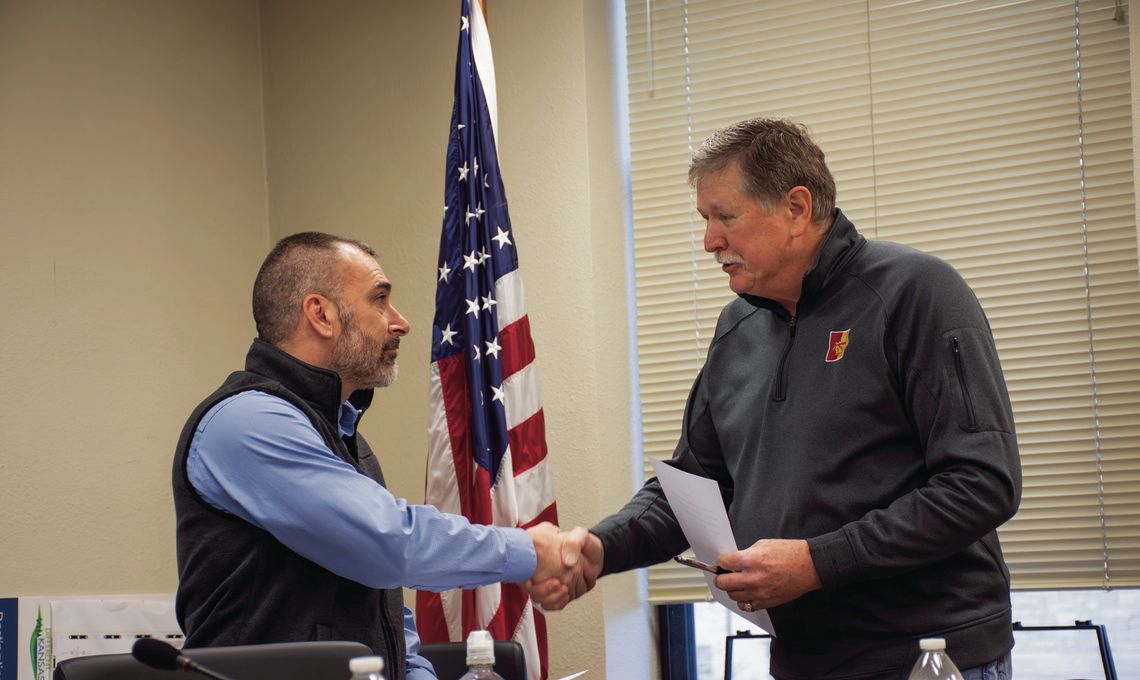
Dr. Jason Sharp, the newly named incoming president of Labette Community College, was sworn in during the recent meeting. Sharp will take over as president after Dr. Mark Watkins retires in July. Another board member, Montie Taylor, who is also an LCC Trustee, presented the oath of office.
The board approved many regular annual items of business, including appointing ex officio members, signing a waiver to allow the group to budget based on a modified cash basis, and setting the calendar of meetings for the year. Meetings are to occur on the third Thursday of each month, at 8 a.m. in the City Commission Room of the Parsons Municipal Building.
The 2026 budget was also approved. According to Great Plains Industrial Park Director Brad Reams, the projected budget is relatively flat, but anticipated that may change in the coming months.
During public comment, Labette County Zoning Administrator Mel Hess was the first to speak. He asked if there was any knowledge of when Deep Fission would be holding the community stakeholder meetings. Previously, it was reported that Deep Fission expected those to begin in late January. During December’s meeting, he said he was overloaded with calls in the aftermath of the Deep Fission announcement, and on Thursday, he said he was still receiving numerous calls with questions.
Charles Carney, a Kansas City, Kansas resident, presented a statement.
“I oppose this project because it will put members of this region in grave danger of exposure to deadly toxins brought by nuclear war, I’m talking about the fission project,” Carney said.
He added that long-term storage of nuclear waste poses risks of seismic activity and geological instability.
“Approval of this project places corporate interests above democratic processes, and it is also against human rights. It advanced profits over people,” Carney said.
He noted that there is the risk of human error during transportation and storage of nuclear waste, and said it should scare the living daylights out of area residents.
“An injury to the people of Parsons and Labette County is an injury to us all, and that’s why I’m here, because I don’t want to see projects like this get started and then expand to Wyandotte County, where I live,” Carney said. “So I ask that you stand for justice, stand for democracy, and stand for our right to live in a clean, safe environment and stop this nuclear cauldron in its tracks.”
Anne Suellentrop, another Kansas City Resident, who has previously spoken at a Labette County Commission meeting, said that nuclear energy is the evil twin to nuclear weapons. Suellentrop is involved with organizations that oppose nuclear weapons, such as the Alliance for Nuclear Accountability and Physicians for Social Responsibility. Suellentrop is also the Vice Chair of Peace Works, another such organization.
Through such organizations, Suellentrop said she has spent a lot of time speaking with people impacted by contamination caused by nuclear waste. She provided an example she brought up during her visit with the Labette County Commission. While visiting California, Suellentrop said she met two mothers, who met while their kids were undergoing cancer treatment. The women learned that they lived on the same street, and eventually they learned that their children’s cancer was caused by nuclear waste moving down with rainfall. She also noted that women and children have a higher risk of developing cancer caused by radiation.
“So we’re looking here at short-term gains for long-term pain,” Suellentrop said. “These projects are being rushed, and I’m wondering: why is that? Where is the environmental oversight? Where is the democratic process?”
Suelentrop said the Depp Fission project in Parsons is a national issue.
“People are talking about Parsons, Kansas, now, nationwide. They see this as a way that the government will try to force this.”
She said that 10 years ago, Deep Isolation was unsuccessful in its mission to place boreholes beneath existing nuclear energy plants throughout the country.
Deep Isolation’s universal canister system was recently deemed safe and ready to use by the Department of Energy earlier this month.
Deep Isolation is a company founded by the same father-daughter duo who founded Deep Fission — Elizabeth Muller and Richard Muller. According to Deep Isolation, their method places nuclear waste deep underground, where its isolation can be tested and verified for safety and longevity.
A Jan. 13 press release from Deep Isolation noted that the company has recently completed Project Savant, a two-year research project funded by the Department of Energy.
According to the press release, the project found that Deep Isolation’s Universal Canister System and borehole casing materials can sufficiently resist corrosion to safely store nuclear waste material, further validating the design and advancing the company toward a full-scale deep borehole disposal demonstration.
“This important study shows that Deep Isolation has achieved another critical milestone in the development of a safe method of disposing of radioactive nuclear waste – something the world critically needs,” said Deep Isolation’s President and CEO Rod Baltzer in the press release. “Nuclear energy is facing a growing challenge. Global nuclear power capacity is forecast to increase by more than 300 GW by 2050, yet the world has not permanently disposed of any of the spent fuel it has created over the last 70 years. We believe our deep borehole technology will ultimately be the solution for safe and permanent disposal of nuclear waste deep underground, a solution the world needs.”
Also quoted in the article was Executive VP of Engineering Jesse Sloane, who said: “The project SAVANT data significantly strengthens our understanding of how UCS and borehole system materials perform under the conditions expected in a deep geologic environment. These results demonstrate wide margins of safety for the public and reinforce the robustness of our design approach. With these results in hand, we are well-positioned to advance into larger-scale testing.”
See FISSION, Page 7.
According to an academic paper written by Matt Waples, Ethan Bates, Stan Gingrich, and Andrew Griffith, — which was referenced in the press release, high temperature, high pressure testing suggests that UCS canisters surpass regulatory requirements for retrievability as well as containment and confinement. It also said further study may be warranted to better quantify other corrosion phenomena and any compounding effects they might introduce.
In closing her remarks, Suellentrop encouraged the board to listen to experts, such as physicist Dr. Ed Lyman, of Princeton University and the Union of Concerned Scientists.
Marjorie Reynolds, a Montgomery County resident with ties to Labette County also addressed the board. She said that she has founded an organization called the Prairie Dog Alliance.
“Our concerns center around who is going to be responsible if this company has an accident in this area,” Reynolds said.
She said she was concerned about insurance and the limited liability of insurance for nuclear projects. She also highlighted concerns regarding the drastic decrease in Nuclear Regulatory Commission employees.
“Are you willing to pay for your children and grandchildren’s health with this project? Because I am not,” Reynolds said.
She said she was speaking on behalf of over 100 relatives of hers who live within 30 miles of the site, and added that she was appalled and that the board has not done its due diligence to have experts outside of Deep Fission weigh in on the project, which she mentioned at the last meeting. The board explained then that prior to the project going public, they could not speak due to nondisclosure agreements.
“There’s been a considerable amount of research done by all of us here,” Board Chair Bob Wood said.
Reynolds also presented a list of questions and concerns to the board.
“It just seems to me like in this case, there are emergency exceptions made for the process when there is not an actual emergency,” Ridgway said. He noted that while he understands the need for economic development, he stated there is no urgent need for AI data centers.
It has been perpetuated by many individuals that the power produced by Deep Fission will be used to attract a data center to Great Plains Industrial Park. However, current projections by the company estimate that it could be 2028 before Deep Fission would be ready to provide commercial electricity. There are no imminent plans for a data center coming to Great Plains Industrial Park.
Leah Connor, another Pittsburg resident, posed questions on how the project would impact property owners and valuation should an accident occur, and again posed the question of how people could insure themselves against nuclear contamination.
“Those details will have to come in the process from Deep Fission and the people that are working in their public meetings, and those questions can be asked,” Wood responded. “All of the questions that have been brought up today will be addressed as we go forward.”
Wood noted that GPDA board members are not nuclear experts and that agencies such as the Department of Energy, the Nuclear Regulatory Commission, and Deep Fission are the ones equipped to answer such questions.
“There is a lot of process coming ahead of us to dive into these types of issues. They are not things that we take lightly,” Wood said. “We certainly don’t want to support a project that is going to cause any harm in Labette County. That’s first and foremost.”
The next Great Plains Development Authority meeting will be on Thursday, Feb. 19, at 8 a.m. in the City Commission Room of the Parsons Municipal Building. For more background on the Deep Fission project, see the “Deep Fission breaks ground on first-ever borehole reactor in Parsons” article published in the Dec. 12, 2025, edition of the Parsons Sun.