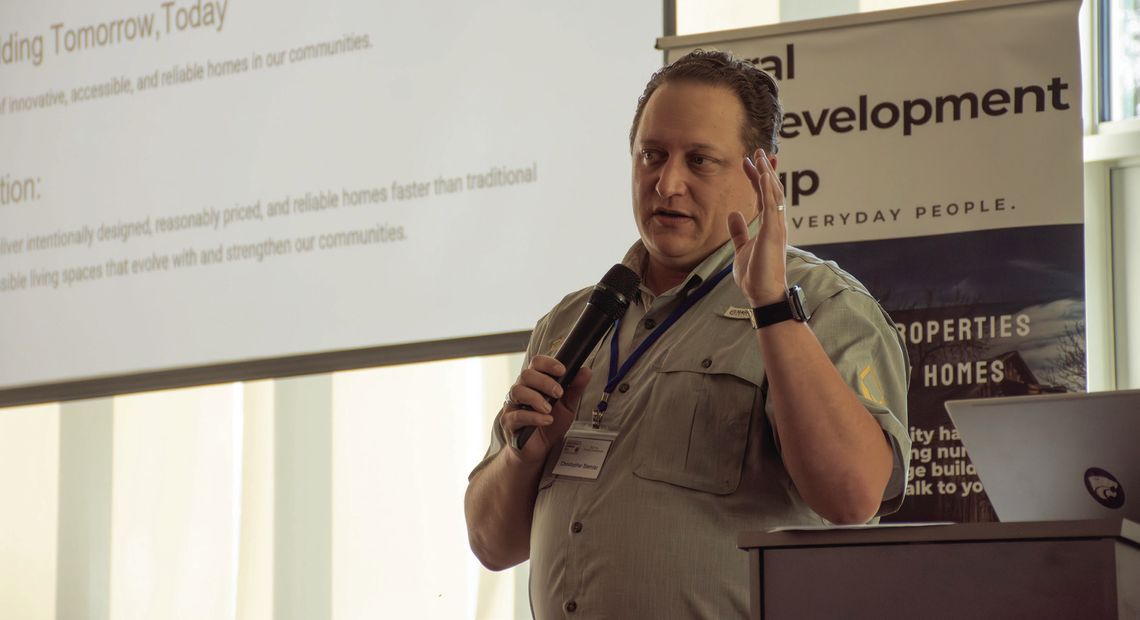
Hannah Emberton [email protected] CHANUTE — A Topeka-area serial entrepreneur sees a solution to the housing woes felt in southeast Kansas. Christ Stemler, owner of Trident Homes, suggests that 3D printed, concrete homes can be built quickly, stronger, and with higher energy efficiency, while remaining priced for the average home buyer. He explained how it could be done during the Southeast Kansas Inc. housing conference in Chanute, Nov. 5.
Through other projects, Stemler said he became frustrated with the building process. He noted that in Independence, he was working on a project which had an anticipated cost of $8-10 million to build 20 housing units over a four- to six-year construction period.
“That’s not great,” Stemler said. He said he looked at the costs and the amount of time his team was spending on the project and began to ask what they could do to change it.
“And soon, my phone or the algorithm was just listening to me. I was traveling, and YouTube plays this 3D concrete printing clip,” Stemler said. “I looked at that, and I was like — wait a minute — if this isn’t AI, if this isn’t just some crazy fake picture, there is something to this.”
Stemler said when he returned home, he called a neighbor and friend who is an architect.
“I showed him the video, and I said, ‘Do you want to help me go on some kind of crazy journey?’” Stemler said, noting that this began nearly four years ago. “From that time to this, a lot has changed.”
Last year, Trident Homes bought its first concrete printer. Stemler said he intends to use this technology to partner with entities in southeast Kansas to bring more accessible housing construction to the region.
“I’m really tired of housing and the current state that it is in. I believe personally that housing really is a right, not a privilege,” Stemler said. “We can’t expect the best from people if they don’t know where they are going to live, or if they don’t know how they are going to support or protect their families, or how they’re going to be fed. It’s just true.”
Stemler said people can’t prioritize building their careers when they have to prioritize keeping a roof over their head.
“What we want to do is create really intentionally designed housing, but what I don’t want you to do is pigeon-hole us into affordable housing,” Stemler said. “And I want you to not use the term ‘affordable.’ Not because these will not be affordable, but because the common conception with affordable housing is ‘cheap.’” Stemler said these homes were standard- style single or multi-family developments, with a wide variety of options for finishings.
“It is reasonably priced. That $70,000 median area income that somebody mentioned — they can afford these houses,” Stemler said, referring to a statistic quoted by another person at the conference.
According to U.S. Census Data, the median annual income across the state of Kansas is roughly $75,500. In Labette County, the median household income is roughly $55,400; Montgomery County, $53,200; Neosho County, $55,700. Other southeast counties’ median incomes ranged from $48,000–$67,000.
He highlighted the benefit of what Trident Homes is planning is that each of the printers could produce between 50 and 150 units per year.
While Trident Homes can not single- handedly tackle the state’s estimated 43,000 housing unit deficit, Stemler said after testing in Topeka, the first stop for the company is likely southeast Kansas.
Of current problems in the construction process, Stemler said a big issue was on the supply side.
“There is not nearly enough supply being created in the places where there is demand,” Stemler said. “Each one of you probably have people who work in your municipalities who live in either a different municipality or out of state.”
Stemler said there is a similar problem in Topeka.
“They go live in Manhattan, or Jefferson County, or somewhere else where they can find or afford housing,” Stemler said.
He noted that those commuter situations do not help communities. He said that when a business spends money and time to bring said business to a municipality, and the income earned by the employees is spent in other communities, it cheapens the benefit of bringing in a business, and the incentives spent by the city bring them in.
Stemler said another portion of the problem has come from the subprime mortgage crisis of the late 2000s. He said 2008 created a problem.
“The developers and builders who survived 2008-2010 were folks who were well-capitalized, or who had good loans and good banking. Those are typically either wealthy developers and builders, or just the older group that had that established,” Stemler said. “So all these young developers who should have been developing from 2008 to 2020 weren’t, because they were no longer in business. They were supposed to be creating the supply, and they’re gone. They don’t exist.
Stemler said the surviving businesses are now retiring. He noted that the housing unit deficit grows every year, which he claims is not good for economic development.
“When I bring up Montgomery County or Independence to banks, do you know what the first thing they tell me is when I look at getting loans for development in those areas?” Stemler asked rhetorically.
He said those institutions point out the declining population rates.
“They think it’s going down because small-town Kansas is dying, because they don’t have perspective,” Stemler said. “The real issue is: there is nowhere for anyone to freaking live. How many houses are currently for sale? How many rentals are in Montgomery County right now? Not many, right?”
Stemler said that the goal for Trident Homes is that when individuals or couples can’t find an existing home that suits their needs, they can choose to build. He noted that most assume they can’t afford to build their own home, but with 3D printed framing, Stemler said many can.
Stemler said that the vertical components of the house, from slab to roofline, can be printed within 3-7 days, or faster. Concrete is batched on-site, under a tent.
The printer builds the external and internal walls, with the hollow space being filled with spray insulation on the exterior wall.
“We think from slab to keys, being finished and move-in-ready, we think we can hit about 60-90 days,” Stemler said.
See HOMES, Page 8.
In other aspirations, Stemler said the goal was to work with the local professionals in the communities they are building in for roofing, plumbing, and electrical work.
“By and large, we’re going to try and spend all this development dollar in or around the local municipalities,” Stemler said.
Stemler noted that in terms of broader economic development, it could be beneficial to partner with employers to offer a housing stipend, which can go much further when a home costs $150,000 as opposed to $300,000 or more. Stemler said the current prices for Trident Homes’ 3D printed homes range from $125,000 to $250,000.
“If that supply problem exists in a place like Gardner, Kansas City, or Overland Park, it’s going to be really hard to convince a developer to come down here, find trades down here, find staff down here to build a house for half the price they could sell a house for up in that area,” Stemler said. “The benefit to our technology is that it doesn’t necessarily matter where we are, because our costs tend to stay pretty much the same.”
Stemler said the biggest expense was the staffing. Each build crew is typically made up of six individuals, and Stemler said employees are paid above the median income.
He noted that this technology could potentially become a workforce development opportunity, as the 3D printing technology that many high school, college, and technical students are learning to use is the same technology that Trident Homes uses, and that the printer is controlled with an Xbox gaming controller.
“This is going to be a great opportunity to capture youth and youthful employment in municipalities in a way that some jobs can’t. And we don’t have to spend 20 years teaching them the art of framing. We just train them on a computer program,” Stemler said. “Half of them already know it because they’re 3D printing toys at home already. It’s the same type of software.”
Of the buildings themselves, Stemler noted that the building process is up to the international building codes, and each printing process is filmed. They are F4 and F5 rated for tornadoes.
Of energy efficiency, Stemler said these builds are typically 70% more efficient than a stick-built home.
Stemler said that land banks can be another impactful component of development.
“This is one of the best ways we can work together, because we don’t mark up the land when we get it,” Stemler said. “If we’re getting that land as an incentive, that incentive should be passed back to the people that you guys want to live in your communities.”
Stemler said his goal is to build 50-100 homes each year for the next two years.
He noted that most communities should start their long-term housing plans with demolition and infilling lots. While the most efficient use of the printer is to print multiple houses in a row, using it to build on infill lots is the next best use.
Stemler said economic developers should also try to reach their private business partners and large local employers.
“If they don’t start subsidising housing, they’re going to lose their workforce,” Stemler said. “It’s coming pretty quick.”
Stemler said there are plans to build some example homes in southeast Kansas, with a first site expected to begin building in Parsons during the first quarter of 2026.
Editor’s Note: More stories of housing innovation will be shared in future parts of the Finding Home on the Range series. In previous editions of this series, readers will recall reading about modular building in Chanute; how tax credits and incentives have helped build and maintain homes in Coffeyville; and how an innovative high school construction program has built homes in Altamont and Bartlett. This is the return of the series after a several-week hiatus. More stories of housing innovation will be shared in future parts of the Finding Home on the Range series. The Sun has received questions from readers about aspects of building and housing availability, which we aim to address in future parts of this series. If one would like to submit a question, email [email protected].