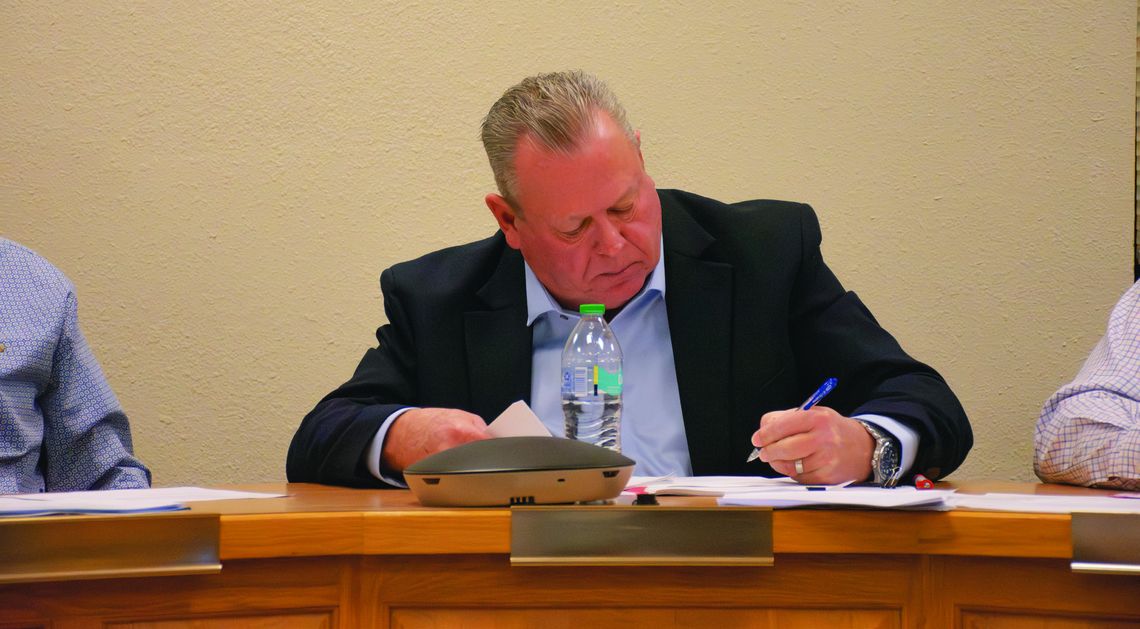
The Great Plains Development Authority met on Thursday, Dec. 18, for a regular meeting. During the meeting, a new agreement was signed with Evergy. This agreement would allow them to build a new solar farm at Great Plains Industrial Park.
A review of the year was held at the start of the meeting. This report highlighted that the board has signed 23 nondisclosure agreements, which Great Plains Industrial Park Director Brad Reams said are typically signed in the early stages of a company coming to Great Plains Industrial Park.
“As we are able to explain confidential information about what we have going on, they’re able to give us information about maybe their technology that they use, maybe their business financials, share that with us,” Reams said.
Reams said an NDA will often come after an introductory call, and both parties agree they are interested in the prospect.
Two memorandums of understanding were signed, which Reams said would usually be signed after an NDA.
In total, five agreements were sold through November, and 22 Department of Commerce projects have been submitted, which is within the average of 20-25 per year.
Efforts to improve search engine optimization have paid off.
“Our users are up 159%, and our sessions are up 93%,” Reams said.
The park also received designation as a bioenergy zone and a BBB rating. This denotes an area having a good prospective viability for feedstock and infrastructure. This rating was announced in April of this year.
In other projects, an annual review was had of the Kansas Army Ammunition Plant site, with the Army Corps. of Engineers and the Kansas Department of Health and Environment. Two new tenants were welcomed to the park, and several companies visited the park this year.
After this review, the board addressed transparency concerns regarding the Deep Fission project.
“We were given permission to share some information with the public on this project,” Reams said prior to reading a written statement from Deep Fission. “This is information we have shared with our congressional leaders, our legislative leaders, and also with our local public officials as well.”
Board member Brian Williams, who is also the president and chief executive officer of Labette Health, noted that he was really impressed with Elizabeth Muller, the CEO of Deep Fission.
“She mentioned that they wanted to communicate a lot earlier with the public, but the Nuclear Regulatory Commission, at the federal level, directed them not to.”
In Deep Fission’s statement, it was reiterated that this project is part of the Department of Energy Pilot Program.
“The extent of the pilot program is to take the reactor critical, meaning allowing the fuel to be placed into the reactor and be turned on by mid-2026, nothing more,” Reams read.
The statement noted that this was the only thing going on with Deep Fission at this current time.
“The DOE pilot project accelerated the permitting process, but it does not circumvent it. All regulatory requirements of nuclear will need to be followed, and the Nuclear Regulatory Commission will have to sign off on Deep Fission’s plan before Deep Fission can go critical.” Reams read.
It was explained that even if Deep Fission gets a hole dug and fully encased, it is possible that the DOE might not sign off on the project.
“If they do it, it is because Deep Fission has met all of the federal requirements to go critical with a nuclear reactor,” Reams read.
The project is reported to have several phases, with phase one, the current phase, being to drill a calibration well, where the geology of the area is confirmed. Phase two will include drilling the main borehole, which is estimated to begin April 1, 2026. It was noted that Deep Fission will need to obtain an underground injection well permit from KDHE. This permit must be obtained, even though it was reported that Deep Fission will not be injecting anything into the ground.
“The permit process will include public notice and public meetings, as with any injection permit in Kansas,” Reams read.
In phase three, the borehole will be encased in concrete and cement to seal the borehole off from the subsurface geology.
“Finally, if the Department of Energy signs off on the project and gives it its required permits, Deep Fission can go critical with a small reactor,” Reams read.
The initial experimental reactor will be able to generate about one megawatt.
“The reactor will not produce electricity. It will only prove that the reactor plan can work at that depth,” Reams noted.
If the first reactor proves the concept, Deep Fission plans to pivot to commercial generation, and future borehole reactors may be built with a capacity to produce 15 megawatts.
Mandates require that any hole drilled by Deep Fission be covered by a bond to ensure that the borehole can be decommissioned, even if the hole does not go critical.
Reams read that the DOE, through the NRC, issues permits for critical reactors.
“If something happens to the reactor, the DOE has jurisdiction over how the waste is handled,” Reams said. “At this time, we believe they would ask Deep Fission to bring the reactor to the surface, dry cast the waste, and store it in a long-term facility.”
One example was the Wolf Creek storage facility in Burlington.
According to the statement, there is no possibility of this reactor going “prompt critical,” which is the type of catastrophic accident that occurred during the Chernobyl disaster in the Ukraine in 1986.
“Prompt critical is when a reactor heats up so fast that it explodes, rather than just melting down,” Reams read. “Deep Fission’s reactor cannot go prompt critical under any circumstances.”
It was noted that Deep Fission will not be moving water in and out of the boreholes, but that the borehole will be filled with water to provide the downward pressure needed for the reactor, with that water staying in the borehole.
“There is no risk of constant exchange of water with other water sources,” Reams read. “Great Plains will provide the water.”
It was also reported that the water within the borehole cannot interact with subsurface groundwater at any level, due to the casing.
The reactor is designed to use low-enriched uranium, which is the same kind of uranium used in current operating reactors throughout the country.
It was noted in the discussion that this low enrichment means that the reactor has a very minimal risk of being the target of a terrorist attack.
The statement reported that community and stakeholder meetings would begin at the end of January.
“I think one of the main things to remember about this is that nuclear is probably the most highly regulated power industry in the world. Especially in our country,” Board Chair Bob Wood said. “It’s not going to be our board’s decision on whether this is a successful project or not. It’s going to be the decision of the Nuclear Regulatory Committee, Kansas Corporation Committee, and Kansas Department of Health and Environment, and all the other entities that will oversee this as we go through the process.”
As far as Evergy’s solar project, Evergy Clean Energy Development Director Brandon Sack noted that they have been working toward this project since 2021 in negotiations with Southwest Power Pool.
“Now we get to negotiate with them and try to get it across the finish line,” Sack said. “So thank you very much for working with us to extend this agreement.”
Sack noted that once more financial work is done to get a full picture of the costs, the project will be presented to get approval from local commissions.
The board formally approved the lease extension during the meeting. In the original agreement, Evergy will lease 2,400 acres for 30 years, and will provide solar electricity generation, with a capacity of 200 Megawatts. This extension adds an additional three years to account for the lengthy approval process with Southwest Power Pool.
“It’s just another component of developing energy for use at the park, which is in high demand right now.”
He board also heard some public comments and took questions ahead of an executive session. In post-session actions, a three-year Master Services Agreement with Smart City Labs was approved.
The Great Plains Development Authority meets on the third Thursday of the month in the City Commission Room at City Hall, at 8 a.m. The next meeting is scheduled for Thursday, Jan. 15, 2026. To learn more about Great Plains Industrial Park, visit https://www.greatplainsindustrialpark.com.