Deep Fission breaks ground on first-ever borehole reactor in Parsons Here is what we know about the project that popped up seemingly overnight
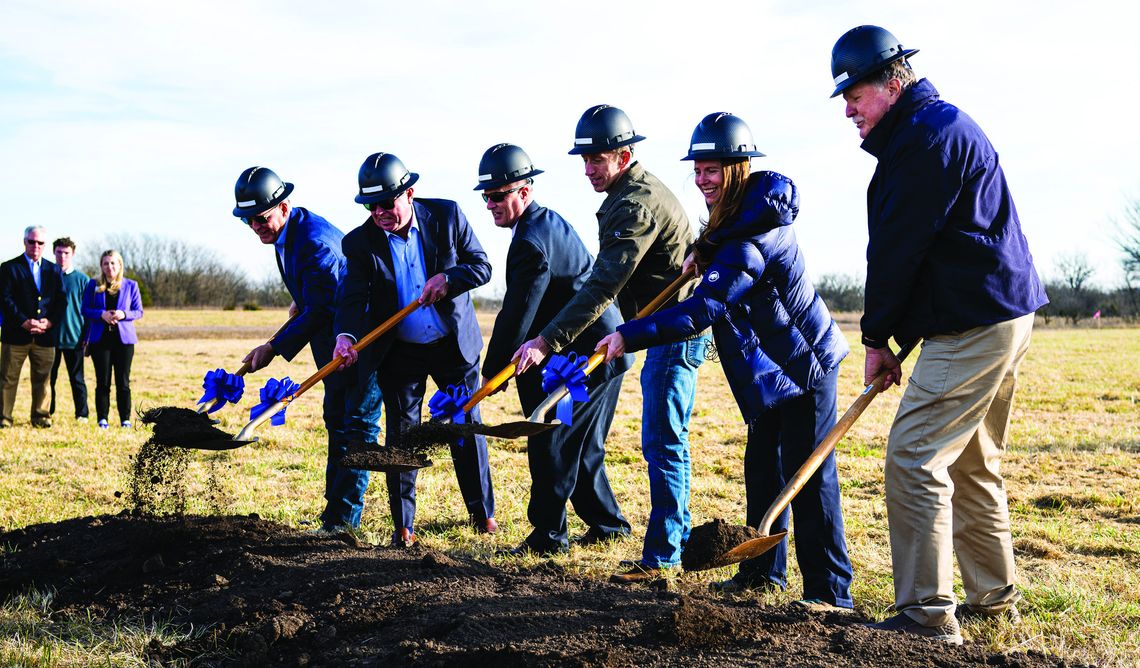
In last week’s breaking news, Deep Fission announced that Great Plains Industrial Park in Parsons was selected as the site for a new type of nuclear reactor. A groundbreaking ceremony was held Tuesday, Dec. 9, with many questions still surrounding the project.
In the wake of the news, many Parsons residents have questions concerning the approval process, safety, efficacy, and what impact this project will have on Parsons’ environment and the economy.
Department of Energy Pilot Program
Back in May, President Donald Trump signed several executive orders relating to nuclear energy. The “Reforming Nuclear Reactor Testing at the Department of Energy” order states: “The United States led the development of civilian nuclear power through the Atomic Energy Commission, the National Reactor Testing Station (now known as Idaho National Laboratory), and several other Federal Government entities. This work produced safe and abundant energy. But in the decades since, commercial deployment of new nuclear technologies has all but stopped. The Idaho National Laboratory has principal responsibility for constructing and testing new reactor designs; it concluded construction of new reactors in the 1970s. Our proud history of innovation has succumbed to overregulated complacency.
As I stated in Executive Order 14156 of Jan. 20, 2025 (Declaring a National Energy Emergency), the United States needs a reliable, diversified, and affordable supply of energy to drive development of advanced technologies, manufacturing, transportation, agriculture, and defense industries, and to sustain modern life and national security. Nuclear energy is both vital to this effort and has never held so much promise. Decades of research and engineering have produced prototypes of advanced nuclear technologies that incorporate passive safety mechanisms, improve the physical architecture of reactor designs, increase reactor operational flexibility and performance, and reduce risk in fuel disposal.
Advanced reactors — including microreactors, small modular reactors, and Generation IV and Generation III+ reactors — have revolutionary potential. They will open a range of new applications to support data centers, microchip manufacturing, petrochemical production, healthcare, desalination, hydrogen production, and other industries.
The United States cultivated the effort to design and build the first Generation IV reactor for commercial use, but the federal government has effectively throttled the domestic deployment of advanced reactors, ceding the initiative to foreign nations in building this critical technology. That changes today. It is the policy of my administration to foster nuclear innovation and bring advanced nuclear technologies into domestic production as soon as possible.”
With this order, Trump also authorized a Department of Energy Pilot Program to support nuclear research outside of the Idaho National Laboratory.
This executive order also states that the pilot projects fall under the jurisdiction of the Department of Energy and the Secretary of Energy Chris Wright for approval.
Of environmental reviews, the order states: “The secretary shall, in consultation with the Chair of the Council on Environmental Quality, take action to reform the Department’s rules governing compliance with the National Environmental Policy Act,” as well as, “The Secretary shall, consistent with applicable law, use all available authorities to eliminate or expedite the Department’s environmental reviews for authorizations, permits, approvals, leases, and any other activity requested by an applicant or potential applicant.”
In August, 11 advanced reactor projects were announced to be a part of the pilot program. In that release by the Department of Energy, it was said: “DOE will work with industry on these 11 projects, with the goal to construct, operate, and achieve criticality of at least three test reactors using the DOE authorization process by July 4, 2026. Today’s initial selections represent an important step toward streamlining nuclear reactor testing and unleashes a new pathway toward fast-tracking commercial licensing activities.”
The 11 companies chosen are: Aalo Atomics Inc., Antares Nuclear Inc., Atomic Alchemy Inc., Deep Fission Inc., Last Energy Inc., Oklo Inc., Natura Resources LLC, Radiant Industries Inc., Terrestrial Energy Inc., and Valar Atomics Inc.
According to this press release, each company will be responsible for all costs associated with designing, manufacturing, constructing, operating, and decommissioning its test reactors.
The local approval process, or lack thereof
Many have asked how this project could suddenly be breaking ground less than a week after many were first learning about it. While some online have accused the Parsons City Commission or Labette County Commission of hiding the project, the truth of the matter is that neither entity has authority over the project.
When asked about the approval process, Mayor Verlyn Bollinger said there was no approval process. He said he was informed of the possibility of such a project coming to Parsons, but the commission was not informed of Parsons being chosen for the project or the groundbreaking ceremony until the day prior to Deep Fission’s press release announcing their location at Great Plains Industrial Park.
Due to an already scheduled Kansas Association of Counties Conference in Wichita, none of the Labette County Commissioners were present at the groundbreaking.
“It caught everyone off guard,” Labette County Commission Chair Vince Schibi said of last week’s announcement.
Schibi said roughly a month or more ago, he attended a meeting with the Great Plains Industrial Park Board, and he was informed of the possibility of this project choosing Great Plains Industrial Park as its location.
“We put out that statement,” Schibi said, referencing this statement from Deep Fission’s press release: “The Labette County Commissioners are pleased to support the joint venture between Great Plains Industrial Park and Deep Fission as part of the Department of Energy’s Pilot Program. We are committed to backing projects that provide jobs, energy, and economic growth for the citizens of Labette County.”
“We should have added, ‘Providing it is safe to the residents of Labette County,’” Schibi said.
Of the project timeline, Schibi noted that the process was moving faster than expected, but highlighted that the county commission does not have authority over the project. He said the commission was “cautiously moving forward.”
“The county commission can’t grant a permit to put nuclear waste in the ground.”
Schibi said that commissioners and residents alike will need to learn more about the project, and said the commissioners have been told that stakeholder meetings will be held in the near future.
“It could be a game changer for Labette County,” Schibi said.
He noted that the commission wants Great Plains Industrial Park to succeed, and that the power generated by Deep Fission in the future could provide power for the park, and beyond.
Typically, a nuclear power plant proposal from an electric company would need to be approved by the Kansas Corporation Commission. However, KCC says it does not yet know what type of jurisdiction they may or may not have over the Deep Fission Project. Deep Fission is not creating energy for electric utilities at this time, as projects in the pilot program are being considered as nuclear research. However, once their research for the pilot program is complete, Deep Fission Chief Executive Officer Elizabeth Muller said there are plans to transition into a commercial electric business. KCC would oversee Deep Fission if as an electrical utility if it were to transition to selling wholesale electricity.
Kansas not a stranger to nuclear
According to the U.S. Energy Information Administration, 16% of the state’s net generation of electricity in 2024 was produced by the only nuclear power plant: Wolf Creek Generating Station, located in Burlington.
Representative Lauren Bohi represents the 15th District and is on the House Committee on Energy, Utilities, and Telecommunications.
“I am just very excited, it feels like Kansas is leading the way in nuclear,” Bohi said.
“I think that nuclear is the future, and so making sure that we are not hampering the state’s ability to continue on and becoming big energy producers, and then energy exporters is going to be huge, going into this next part of what not only Kansas is going to need, but also what the country is going to need.”
Bohi said she was excited that southeast Kansas would once again be put on the map.
“I’m happy for my state, and I’m happy for southeast Kansas.”
Bohi said building on the state’s existing nuclear capabilities is important.
“That is what I think that not only we need but what our country needs, especially with the amount of energy consumption that looks like is coming down the pipe,” Bohi said. “Whether it be for charging electric vehicles, or for data centers, or for just as the grid continues to build out.”
Bohi said she believed increasing the amount of energy Kansas exports would be beneficial to the state.
Muller noted during the ceremony that Kansas was not expected to be the site, and was not initially one of the states considered for the project.
“You all snuck up on me,” Muller said. “We have been so pleased by the vision that you have for advanced energy, for innovation, for bringing jobs and great people to the community.”
Josh Svaty, a former state representative, a former Secretary of Agriculture of Kansas, and a former adviser for the Environmental Protection Agency, welcomed attendees to the groundbreaking ceremony, which began at the Cardinal Event Center.
Svaty said he has been involved with several big energy projects in Kansas, and said one of the reasons Kansas was a great location was due to the existing Wolf Creek plant.
“The language of nuclear is still fairly common in the state of Kansas,” Svaty said.
Environmental concerns
Svaty noted in the ceremony’s opening remarks that he has been excited about nuclear energy in Kansas for many years.
“The Deep Fission team knows that I have been really excited about this moment, this announcement, and this community for a long time. This is truly one of the most exciting things to be announced in the state and in the country in a long time,” Svaty said. “This was dubbed as a groundbreaking, but in reality, it is the beginning of a process that will unfold over the coming weeks and months, and that process will include tremendous public engagement and the opportunity to have a meaningful voice in this process.”
Svaty then noted that all Energy production types have strict rules for operations.
”No energy type has more rules attached to it than nuclear,” Svaty said. “It is subject to all of those very stringent laws that govern the way we do nuclear power in the United States; that includes public engagement.”
No specific date, time, or location of any stakeholder meetings were discussed; however, Great Plains Industrial Park Director Brad Reams said information on those meetings would be announced later, and assured that press coverage and public input would be key in the next steps of the project.
Deep Fission is an answer to Great Plains’ problem
Great Plains Industrial Park Board of Directors Chair Bob Wood described Deep Fission as the egg in a search for which comes first.
“I have been searching for the answer to the chicken and egg debate for several weeks now, or years now,” Wood said. “Which comes first? The tenant or the power? We have tenants that want to locate to our site, but we’ve had a challenge confirming the power demands that come with these developments.”
Woods said Deep Fission has the technology and capability to help solve the roadblock to negotiating with companies that would use the power generated by Deep Fission’s process.
“Their investment in Labette County will be huge, and the jobs created by this process will be a needed shot in the arm,” Wood said. “However, the real win will be the companies that are willing to come to Great Plains because of this power generation.”
Wood said this is why he refers to Deep Fission as the egg.
“It’s the beginning of our process to redirect the future of Labette County and the entire southeast Kansas region,” Wood said.
Since the announcement of Deep Fission, the Great Plains Development Authority has touted the park as a premier location for potential data center development and is actively recruiting a data center to be a tenant in the industrial park.
“We’re also very specifically interested in the data center itself. The Great Plains Industrial Park has a unique opportunity there; because there are users who need that electricity right now, they believe that by bringing us in, they will be able to attract additional businesses to the industrial park. So there is an opportunity to grow over time,” Muller said.
How would this reactor work?
Muller said the Department of Energy is offering the pilot program to show that nuclear reactors can be built safely, and in a timeframe that is meaningful for economic development.
“For so long, nuclear has had a hard time because it takes 15 years to build, and many tens of billions of dollars in order to do that,” Muller said. “Nuclear power is the safest source of electricity that we have today, and yet it’s big. It’s hard to build. It takes many years.”
Muller said nuclear power is an incredibly dense type of energy.
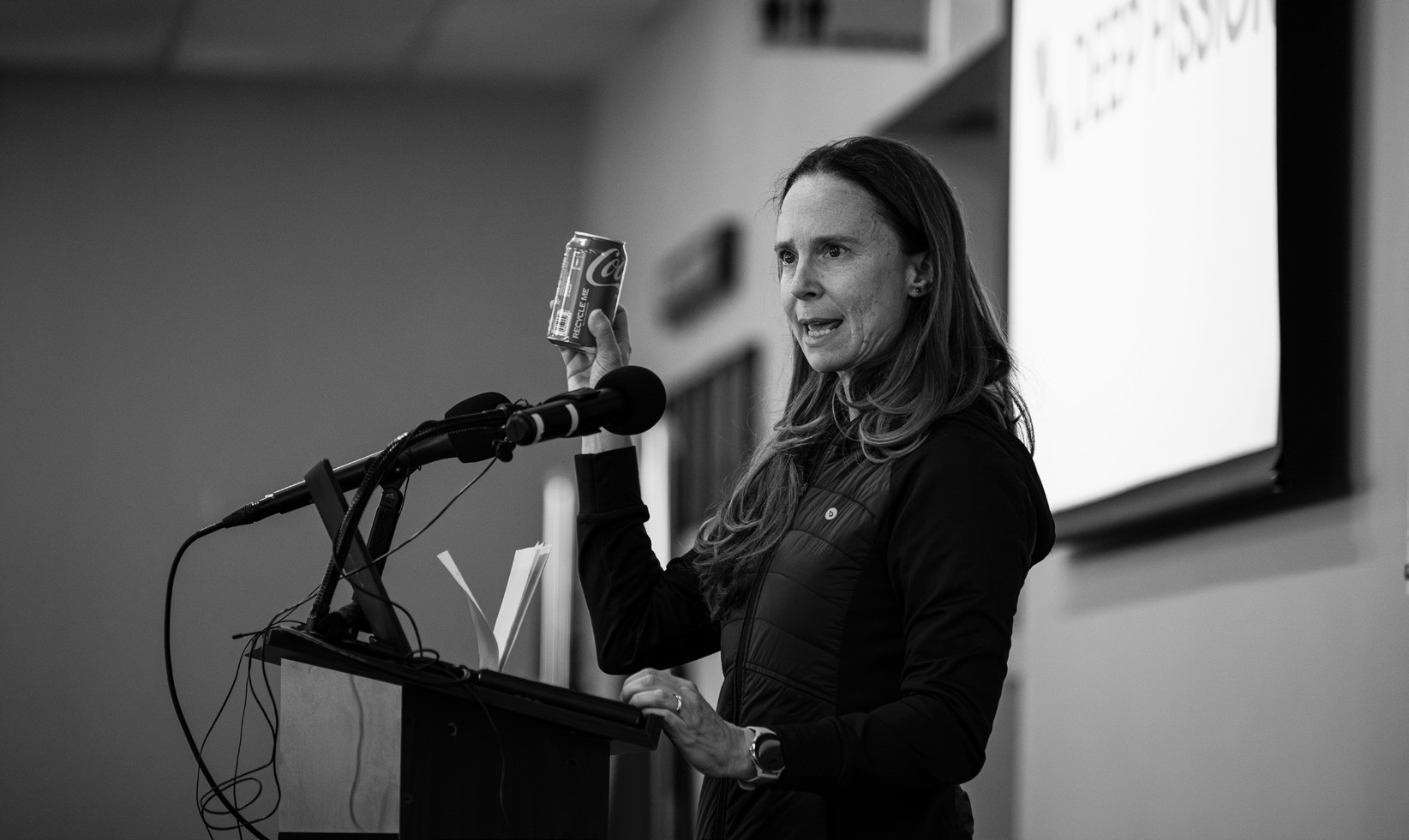
“If I use nothing but nuclear power to power my entire life — all my cars, all my electricity, everything that I did in my life ‚ the fuel that would take me would fit in this soda can,” Muller said while holding up a can of Coca-Cola. “Now that also means that the nuclear waste would fit in this soda can. So it’s not a large volume, but it is challenging.”
Muller said above-ground reactors require lengthy and expensive construction for containment, creating pressure and the cooling systems.
“Those three things are fundamentally why nuclear power is slow and expensive. Now, what we’ve realized with Deep Fission is that by inverting that by putting the nuclear reactor, the core of the reactor, a mile underground, you actually get those conditions without having to physically build them,” Muller said. “We know how to drill. Many people are very, very good at drilling. We know how long it takes to drill a big hole.”
Muller said above-ground reactors have the potential to get into the environment and impact people, but that was less likely in an underground reactor.
“You put it a mile underground, where you are surrounded by billions of tons of rock and a column of water a mile long,” Muller said. “We think this is the safest, the best possible place you can put a nuclear reactor and remarkably, it takes the vast majority of the cost out because you don’t have to build it. You’re working with the natural environment.”
Muller said the reactor will be called Gravity. “We call our rector Gravity because it’s a force of gravity. It’s the gravity of the water that is creating the pressure that we need, and it’s the surrounding rock that provides the containment we need,” Muller said.
This type of pressurized water reactor is the most common kind of nuclear technology; however, using this technology in a borehole for containment is a new idea for reactor design, along with building on current oil and gas industry techniques.
After the hole is drilled and a reactor is built at the bottom of the hole, Deep Fission will fill the borehole with water. The reactor will then heat that water, which will create steam, and turn turbines, which will produce electricity. The steam will cool and condense back into the borehole, so the water is recycled through the system.
Each reactor has a lifespan of two to seven years, and once spent, the reactors could either be removed and sent to a waste facility or sealed off in the borehole and built on top of, if the original hole is deeper than a mile.
“The expensive part of nuclear power is the above-ground construction, so if you imagine a nuclear power plant, you’re probably thinking of a big plant with a lot of concrete, a lot of cement. All of that construction is fundamentally to do three things: it’s to contain everything so nothing can get out and impact humans or the environment; it’s to create a high pressure environment so that you can create electricity from steam; and it’s for cooling systems.” Muller said. “Those three things are the vast majority of the cost of nuclear power, and also the reason that it traditionally takes 15 years to build a nuclear plant.”
Muller said the key insight behind Deep Fission was that in a borehole a mile underground, those three conditions were already met.
“You have the containment — you’re surrounded by a billion tons of rock. You have the pressure because the water that is above you in the borehole is using the force of gravity to push down on your reactor and creates the exact amount of pressure you would want if you’re in a pressurized water reactor,” Muller said. “And the final thing is that all that water is also your cooling system, so the most expensive parts of nuclear power, you basically get for free if you’re in a borehole, a mile underground. Which also means that you can build it dramatically faster and then respond to the growing need for data centers who need electricity soon — not in 10-15 years from now.”
One borehole can produce up to 15 megawatts of electricity, which can power 10,000 homes, according to Muller.
“Now, we’re looking at building multiple boreholes at the site, so that will depend on all the consultation that will happen over the coming months and years,” Muller said. “For example, if we had 100 boreholes, that would be 1.5 gigawatts of power, which is sufficient for a large data center.”
Muller said after the groundbreaking, the next steps involve taking samples of the ground, then the rock throughout the depth of the borehole.
“Finally, we’ll drill a bigger hole, and that will be the hole that we fully case and line with cement that we can eventually use for the reactor itself,” Muller said. “In parallel, we’ll be procuring the fuel that we need and putting it in a canister that we can lower down the borehole. The final step will be when we lower the canister down the borehole and we will allow the fuel to go critical.”
Muller said to go “critical” means to allow the fuel to start a nuclear reaction.
“The reaction will stay at the bottom of the borehole, so everything inside of the reactor never comes up to the surface,” Muller said.
She noted that due to the techniques used, the fuel does not need higher enrichment, as some other companies require.
Of safety, Muller said that nuclear power is the safest source of electricty that exists today.
“The statistics don’t lie, it is extremely safe, but that doesnt change the fact that many people feel fear and have an emotional reaction when they hear about nuclear power, but it is very, very safe,” Muller said. “There is also something to be said about taking that already very safe technology and putting it a mile underground, where it is very hard to come up with any scenario in which there is going to be an impact on humans or the environment.” Muller said Deep Fission would have to demonstrate adherence to very high level of standards, to show that the reactor is completely safe. “That is a process that is detailed, it takes time, but we do expect that we are going to be able to complete that in 2026, when we want to begin operating commercially,” Muller said. “We’ll have to move from the Department of Energy’s authorization to the Nuclear Regulatory Commission, who can regulate commercial reactors. So that is a separate process that will happen after this initial pilot program is completed.”
Of the worst-case scenario, Muller said: “What we have is a loss of the reactor, so if the casing were to break, we may not necessarily be able to retrieve the reactor, but in that case, there is still no exposure to humans or the environment. Because we are so far below the water table, so far below any sort of human activity — so we feel really good about even in that worst-case scenario, there would be an economic loss potential, but it is not an impact to the environment.
The cost of building these reactors is expected to decrease over time, according to Muller, but so far the reactor is estimated to cost $60 million, not including engineering work.
Educating an industry
Kansas State University established what would become the first accredited undergraduate nuclear engineering program in 1958. According to Associate Dean for Engineering Research and Graduate Programs Stacey Hutchinson, the University has been participating in nuclear engineering research for over 60 years.
“Over this time, we have graduated some great engineers who are actually part of the team at Deep Fission,” Hutchinson said.
Several students from the program were present during Tuesday’s ceremony.
Labette Community College President Mark Watkins said this industry moving in, there is another opportunity to design training opportunities for students and the workforce.
“We do have the infrastructure here to be able to pivot, as you say, whenever the market demands different changes, because we want our students to be relevant and upgraded in their skills whenever possible,” Watkins said.
Economic Development Director Jim Zaleski said all the credit for the project goes to Brad Reams and the Great Plains Industrial Park Board.
“It’s a huge step in the right direction,” Zaleski said of the project. “We’ll do whatever we can to support them in the next steps.”
When asked about the potential economic impact and job creation, Zaleski said the current project is a test and that those types of answers are hard to predict with the current information available.
“Let’s just take this step and then see where we are at after that,” Zaleski said.
Muller said that the company would be working with local community colleges and universities to educate nuclear engineers and hire local individuals to operate the reactors.
What is next
Of the ceremony, Great Plains Industrial Park Director Brad Reams said: “It’s a great kickoff to the whole process. With these types of projects, there is a lot of time that goes into it beforehand, and then you’re finally able to celebrate with the public. To me, it’s a great thing for our board.”
Muller said that while the timeline is short, the date is exciting.
“I think we feel really good about building a reactor next year, so you know, what time frame it is precisely is hard to say, but what is very exciting is being able to have a first-of-a-kind reactor that will be built in 2026.”
Following this research reactor, Muller said she hopes to have a commercial reactor running in 2027 or 2028.
This story is still developing, and any updates will be included in future editions of the Parsons Sun.